
TAMARIX ramosissima 'Rosea'
<


>
TAMARIX ramosissima 'Rosea'
Commonly known as Tamarisk
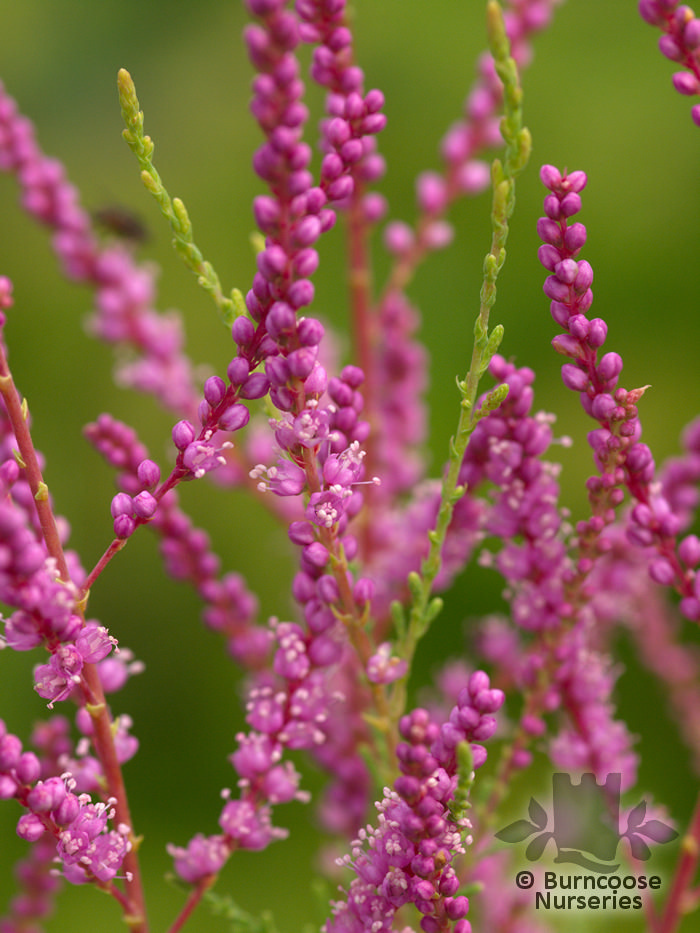
Rose-pink flowers in late summer and early autumn


£17.50 each
MULTIBUY SAVING
Any 3+ £15.00 each
Full Plant Details - Sun/Soil & other attributes
-
Floweringlocal_floristJanlocal_floristFeblocal_floristMarlocal_floristAprlocal_floristMaylocal_floristJunlocal_floristJullocal_floristAuglocal_floristSeplocal_floristOctlocal_floristNovlocal_floristDec
-
 Good to know
Prune regularly to prevent shrubs becoming top-heavy and unstable. Wildlife plant - insects.
Good to know
Prune regularly to prevent shrubs becoming top-heavy and unstable. Wildlife plant - insects. -
 Pests & Diseases
None
Pests & Diseases
None -
 Place of origin
Southeastern Europe to Asia
Place of origin
Southeastern Europe to Asia -
Resistant to honey fungusThese plants have little or few problems with honey fungus.
-
DeciduousPointed leaves to 5mm (¼in) long.
-
 Shades of pink
All shades of pink through to Carmine (red)Rose pink
Shades of pink
All shades of pink through to Carmine (red)Rose pink -
BorderSuitable for a shrub border
-
Coastal / windswept
-
Fully hardy
-
 Filiform
-
 Height
5m (16ft)
Height
5m (16ft) -
Spread
5m (16ft)
-
Tall ShrubGraceful, spreading shrub or snall tree with arching, red-brown shoots. Produces 5-petalled flowers in dense racemes to 7cm (3in0 long on the new shoots.
-
 Pruning group 4
Suitable for: Deciduous trees and shrubs that flower on current year's growth or are grown for winter stem effect.
Pruning group 4
Suitable for: Deciduous trees and shrubs that flower on current year's growth or are grown for winter stem effect.
Pruning: Hard prune to a low permanent framework.
When: Annually in early Spring.
-
 Hardy - very cold winter
Hardy in all of UK and northern Europe. Plant can possibly withstand temperatures down to -20°C (-4°F)
Hardy - very cold winter
Hardy in all of UK and northern Europe. Plant can possibly withstand temperatures down to -20°C (-4°F) -
Autumn Seasonal Interest
-
Spring Seasonal Interest
-
Summer Seasonal Interest
-
Medium to light, fertile, well drained soilIn coastal areas. Inland a more moist soil is preferred.
-
 Full sun
Inland shelter from cold, drying winds.
Full sun
Inland shelter from cold, drying winds. -
 Bee friendly
-
Mature Size5m (16ft)


5m (16ft)
View Detailed Plant Description
View Planting Tips and Care Advice
Tamarix - Growing Guide


