
CARPINUS
<


>
CARPINUS
Commonly known as Hornbeam
Attractive specimen trees grown for their elegant habit, ornamental foliage, autumn colour and pendent racemes of fruit. Male and female catkins on same tree in spring. Hardier than beech and tolerates wet soil much better.
Hornbeams yield very hard timber which is difficult to work. Long-lasting items such as tool handles, coach wheels, shoe lasts and gear pegs for windmills have been worked from this "ironwood".
Genus of about 40 species of deciduous trees from woodland in Europe, Asia and North America.
The UK native C. betulus, most common in the southeast, and rare in Scotland and Ireland, is favoured by the elusive hawfinch which is fond of the seeds which fall from October.
Full Plant Details - Sun/Soil & other attributes
-
 Pests & Diseases
Caterpillars, aphids, coral spot,
-
 Place of origin
China, Korea, Japan
-
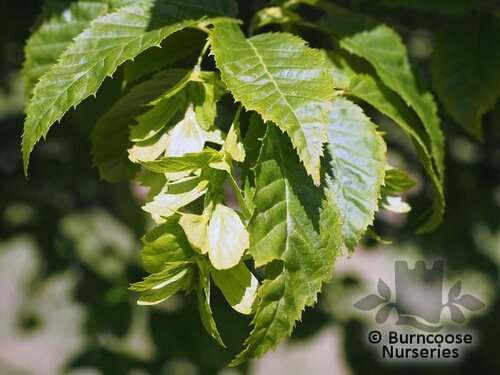
DeciduousSharp-pointed, double-toothed, glossy leaves to 7cm (2¾in) long, dark green above, mid-green beneath, turning yellow in autumn
-
Woodland garden
-
Fully hardy
-
 Double Serrate
-
Ovate
-
 Height
12m (39ft)
-
Spread
12m (39ft)
-
TreeSpreading tree with pendent branch-tips. Produces catkins in spring. Males are green and 1-2cm (½-¾in) long, females are yellow-green to 5cm (2in) long followed by pendent green, later yellow-brown, racemes of fruit 5-7cm (2-2¾in) long
-
 Pruning group 1
Suitable for: Deciduous and evergreen trees, and some deciduous shrubs.
Pruning: Minimal pruning required. Prune wayward or crossing branches to maintain a healthy framework.
When: When dormant in the late winter/early spring. Some in the summer/autumn to prevent bleeding of sap.
-
 Hardy - very cold winter
Hardy in all of UK and northern Europe. Plant can possibly withstand temperatures down to -20°C (-4°F)
-
 Rounded to broadly spreading
-
Mature Size12m (39ft)

12m (39ft)
View Planting Tips and Care Advice
Carpinus - Growing Guide
