
CHAENOMELES
<

>
CHAENOMELES
Commonly known as Flowering quince, Japanese quince
All Flower MAR-MAY
These Flowering quince produce fruit which is palatable when cooked like the Common quince Cydonia oblonga. Flowering quince fruit contains much more pectin; more than lemons.
Shrubs can be grown as a spiny barrier and maintained as bonsai.
Genus of 3 species of deciduous, often spiny, shrubs, one sometimes a small tree, from mountain woodlands in China and Japan.
Full Plant Details - Sun/Soil & other attributes
-
Floweringlocal_floristJanlocal_floristFeblocal_floristMarlocal_floristAprlocal_floristMaylocal_floristJunlocal_floristJullocal_floristAuglocal_floristSeplocal_floristOctlocal_floristNovlocal_floristDec
-
 Good to know
Early flowers for insects. A more prostrate form which is useful for substantial groundcover
Good to know
Early flowers for insects. A more prostrate form which is useful for substantial groundcover -
 Pests & Diseases
scale insects, aphids, canker.
Pests & Diseases
scale insects, aphids, canker. -
 Place of origin
China.
Place of origin
China. -
Resistant to honey fungusThese plants have little or few problems with honey fungus.
-
DeciduousOval, glossy, dark-green leaves 4-9cm (1½-3½in) long.
-
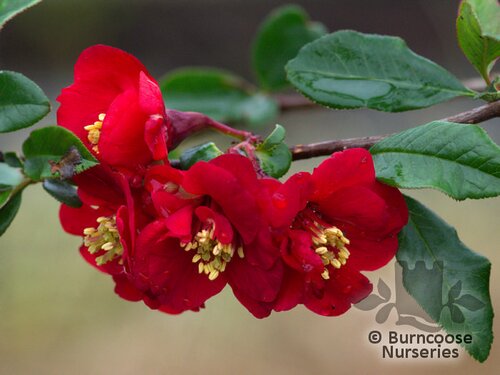
 Red
Red
-
 Semi-double
Two rows of petals with conspicuous stamens
Semi-double
Two rows of petals with conspicuous stamens -
Fully hardy
-
 Height
1m (39in)
Height
1m (39in) -
Spread
2m (6½ft)
-
Medium shrubTypically grow to around 4-6 feet in heightMore prostrate thaproduces flowers 4.5cm (1¾in) across in clusters of 2-4 followed by apple-like, aromatic fruit to 6cm (2½in) long.
-
 Hardy - very cold winter
Hardy in all of UK and northern Europe. Plant can possibly withstand temperatures down to -20°C (-4°F)
Hardy - very cold winter
Hardy in all of UK and northern Europe. Plant can possibly withstand temperatures down to -20°C (-4°F) -
Spring Seasonal Interest
-
Fertile well drained soil
-
 Full sun
-
 Partial shade
-
 Bee friendly
-
Mature Size1m (39in)


2m (6½ft)
View Planting Tips and Care Advice
Chaenomeles - Growing Guide


