
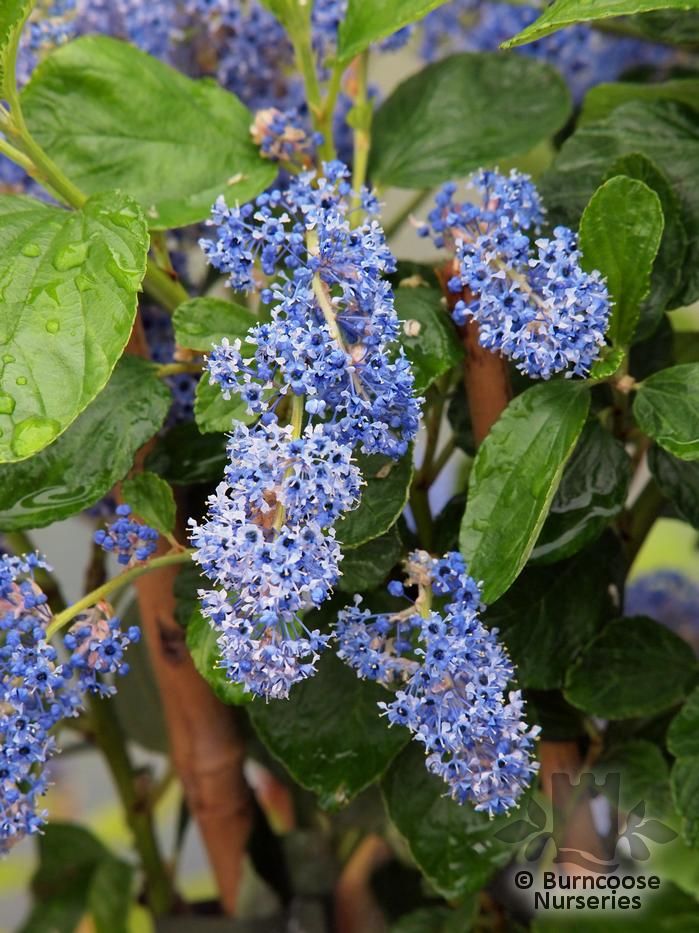
CEANOTHUS arboreus 'Trewithen Blue'
<






>
CEANOTHUS arboreus 'Trewithen Blue'
Commonly known as Catalina ceanothus, Catalina mountain lilac

Largest blue


£16.50 each
MULTIBUY SAVING
Any 3+ for £14.00 each
Large
£40.00
Full Plant Details - Sun/Soil & other attributes
-
Floweringlocal_floristJanlocal_floristFeblocal_floristMarlocal_floristAprlocal_floristMaylocal_floristJunlocal_floristJullocal_floristAuglocal_floristSeplocal_floristOctlocal_floristNovlocal_floristDec
-
 Good to know
Wildlife plant - insects
Good to know
Wildlife plant - insects -
 Pests & Diseases
honey fungus.
Pests & Diseases
honey fungus. -
 Place of origin
Native to Catalina Islands, California, USA. This selection bred at Trewithen Gardens, Grampound, Cornwall, UK
Place of origin
Native to Catalina Islands, California, USA. This selection bred at Trewithen Gardens, Grampound, Cornwall, UK -
EvergreenOval to rounded dark-green leaves to 10cm (4in) long.
-
 Blue
Mid-blue
Blue
Mid-blue -
PaniclesLarge, pyramidal, terminal and lateral panicles to 12cm (4¾in) long
-
BorderSuitable for a shrub border
-
Coastal / windsweptSuitable for an open site slightly back from the sea
-
Cottage garden
-
Town garden
-
Fully hardy
-
 Serrulate
-
Oblong
-
 Height
6m (20ft)
Height
6m (20ft) -
Spread
8m (26ft)
-
Tall ShrubVigorous, spreading shrub or small tree
-
 Pruning group 5
Suitable for: Evergreen shrubs that require minimal pruning.
Pruning group 5
Suitable for: Evergreen shrubs that require minimal pruning.
Action: Trim or lightly cut back shoots that spoil symmetry. Deadhead regularly.
When: Annually after flowering.
-
 Hardy - average winter
Hardy through most of the UK apart from inland valleys, at altitude and central/northerly locations. May suffer foliage damage and stem dieback in harsh winters in cold gardens. Plant can withstand temperatures down to -10°C (14°F)
Hardy - average winter
Hardy through most of the UK apart from inland valleys, at altitude and central/northerly locations. May suffer foliage damage and stem dieback in harsh winters in cold gardens. Plant can withstand temperatures down to -10°C (14°F) -
Scented flowers
-
Spring Seasonal Interest
-
Fertile well drained soil
-
Free draining sandy soil
-
 Full sun
With shelter from cold winds. Most do well trained against a wall.
Full sun
With shelter from cold winds. Most do well trained against a wall. -
 Bee friendly
-
Butterfly friendly
-
Rabbit Resistant
-
Mature Size6m (20ft)


8m (26ft)
View Detailed Plant Description
View Planting Tips and Care Advice
Ceanothus - Growing Guide


