
SYRINGA pinnatifolia
<


>
SYRINGA pinnatifolia
Commonly known as Lilac
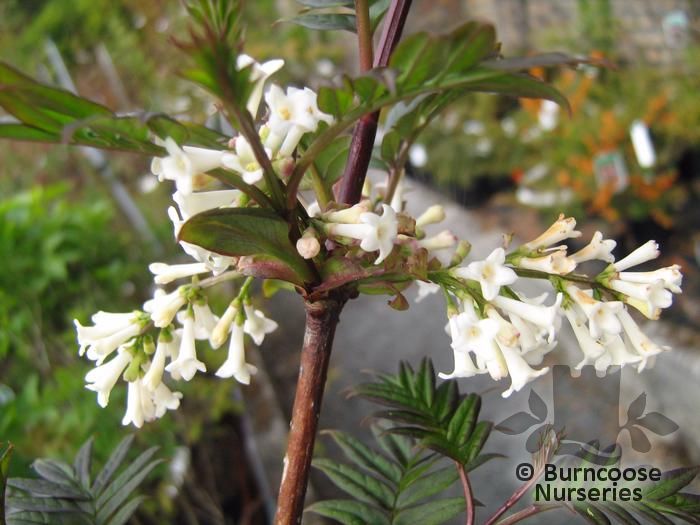
A very unusual species which deserves to be more widely known if only because it looks so unlike a lilac. White or lavender tinted flowers in small panicles in May and long pinnate leaves with 7-11 leaflets


£20.00 each
Full Plant Details - Sun/Soil & other attributes
-
Floweringlocal_floristJanlocal_floristFeblocal_floristMarlocal_floristAprlocal_floristMaylocal_floristJunlocal_floristJullocal_floristAuglocal_floristSeplocal_floristOctlocal_floristNovlocal_floristDec
-
 Pests & Diseases
Leaf miners, thrips, willow scale, lilac blight, honey fungus.
Pests & Diseases
Leaf miners, thrips, willow scale, lilac blight, honey fungus. -
 Place of origin
Western China
Place of origin
Western China -
DeciduousEach pinnate leaf to 6cm (2½in) long has up to 11 oval to lance-shaped dark-green leaflets.
-
 White
White or lavender flowers
White
White or lavender flowers -
BorderSuitable for a large shrub border
-
Coastal / windsweptSlightly back from the sea with more shelter
-
Cottage garden
-
Town garden
-
Fully hardy
-
 Pinnate
-
Entire
-
Ovate
-
 Height
To 4m (13ft)
Height
To 4m (13ft) -
Spread
2.5m (8ft)
-
Tall ShrubOpen, upright shrub with peeling bark on the older branches. Produces panicles of flowers to 7cm (3in) long.
-
 Pruning group 1
Suitable for: Deciduous and evergreen trees, and some deciduous shrubs.
Pruning group 1
Suitable for: Deciduous and evergreen trees, and some deciduous shrubs.
Pruning: Minimal pruning required. Prune wayward or crossing branches to maintain a healthy framework.
When: When dormant in the late winter/early spring. Some in the summer/autumn to prevent bleeding of sap.
-
 Hardy - very cold winter
Hardy in all of UK and northern Europe. Plant can possibly withstand temperatures down to -20°C (-4°F)
Hardy - very cold winter
Hardy in all of UK and northern Europe. Plant can possibly withstand temperatures down to -20°C (-4°F) -
Scented flowers
-
Spring Seasonal Interest
-
Summer Seasonal Interest
-
Fertile moist well-drained soilHumus-rich
-
Neutral to alkaline soil
-
 Full sun
-
 Bee friendly
-
Rabbit Resistant
-
Mature Sizeto 4m (13ft)


2.5m (8ft)
View Planting Tips and Care Advice
Syringa - Growing Guide


