
EUPHORBIA
<

>
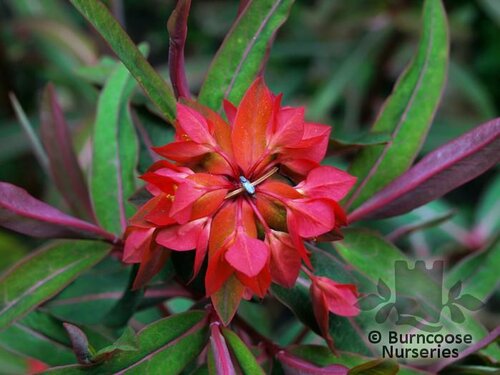
EUPHORBIA
Commonly known as Spurge, Wolf's milk
Very varied genus of about 2000 species of annuals, biennials, evergreen, semi-evergreen or herbaceous perennials, deciduous or evergreen subshrubs, shrubs and trees and succulents.
Many uses including for mixed borders, woodland gardens and rockeries though notice should be taken of the milky sap which can irritate the skin and no part should be eaten.
Many are attractive to insects.
There are 10 UK native spurges, most of which are common.
Full Plant Details - Sun/Soil & other attributes
-
 Pests & Diseases
Aphids, grey mould.
Pests & Diseases
Aphids, grey mould. -
 Place of origin
Portugal, western Mediterranean (garden origin)
Place of origin
Portugal, western Mediterranean (garden origin) -
Evergreenleaves have rolled edges.
-
Frost hardy (down to -5)
-
 Height
70cm (28in)
Height
70cm (28in) -
HerbaceousForms a dense hummock.
-
 Hardy - average winter
Hardy through most of the UK apart from inland valleys, at altitude and central/northerly locations. May suffer foliage damage and stem dieback in harsh winters in cold gardens. Plant can withstand temperatures down to -10°C (14°F)
Hardy - average winter
Hardy through most of the UK apart from inland valleys, at altitude and central/northerly locations. May suffer foliage damage and stem dieback in harsh winters in cold gardens. Plant can withstand temperatures down to -10°C (14°F) -
Well drained, dry, poor to moderately fertile soil
-
 Full sun
-
 skin & eye irritant
Harmful if eaten (People & Pets)
skin & eye irritant
Harmful if eaten (People & Pets) -
Rabbit Resistant
-
Mature Size70cm (28in)
View Planting Tips and Care Advice
Cold weather damage to evergreen plants
Euphorbia - Care Guide
Herbaceous Plants - Video Collection
- Dividing Herbaceous Perennials - Video Tip ondemand_video
- Spring Planting Osteospermums - Video Tip ondemand_video
- Dividing Summer Perennials - Video Tip ondemand_video
- Dividing summer flowering Hemerocallis - Video Tip ondemand_video
- Summer propagation - Video Tip ondemand_video
- Self-seeding aquilegia - Video Tip ondemand_video
- Supporting Plants - Video Tip ondemand_video
- Dead heading meconopsis - Video Tip ondemand_video
- Dead heading Delphiniums - Video Tip ondemand_video
- Feeding herbaceous peonies - Video Tip ondemand_video
- Overpotting Problems - Video Tip ondemand_video


