
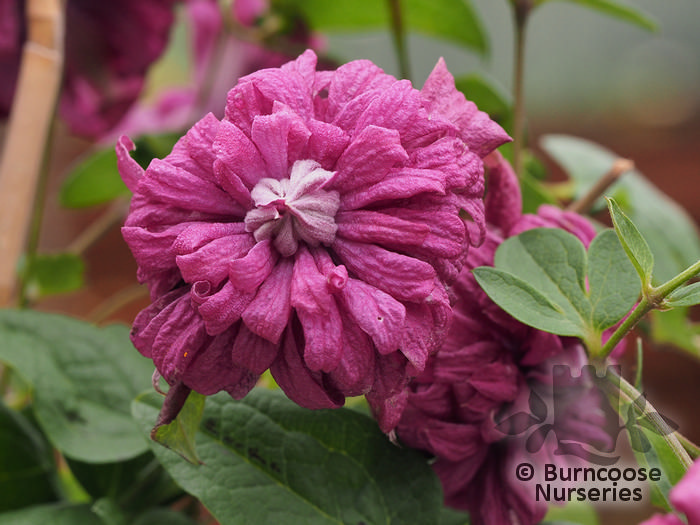
CLEMATIS viticella 'Purpurea Plena Elegans'
<



>
CLEMATIS viticella 'Purpurea Plena Elegans'
Commonly known as Virgin's bower

Double lilac-purple flowers which are paler in the centre


£19.00 each
Full Plant Details - Sun/Soil & other attributes
-
Floweringlocal_floristJanlocal_floristFeblocal_floristMarlocal_floristAprlocal_floristMaylocal_floristJunlocal_floristJullocal_floristAuglocal_floristSeplocal_floristOctlocal_floristNovlocal_floristDec
-
 Good to know
Cut back previous year's stems to a pair of strong buds about 15-20cm(6-8in) above soil level before growth starts in early spring.
Good to know
Cut back previous year's stems to a pair of strong buds about 15-20cm(6-8in) above soil level before growth starts in early spring. -
 Pests & Diseases
cutworms, aphids on young plants, clematis wilt.
Pests & Diseases
cutworms, aphids on young plants, clematis wilt. -
 Place of origin
Garden origin. France. c1900. Probably Francisque Morel.
Place of origin
Garden origin. France. c1900. Probably Francisque Morel. -
Deciduous
-
 Purple
Shades of purple/mauve/lilac/violet
Purple
Shades of purple/mauve/lilac/violet -
Bell/LanternOpen bell-shaped to 8cm (3in) across with 4-6 guard sepals, but no anthers
-
DoubleMulti rows of petals, no stamen showing
-
Cottage garden
-
Suitable for small gardens
-
Town garden
-
Fully hardy
-
 Entire
-
Ovate
-
 Height
2-4m (6½-13ft)
Height
2-4m (6½-13ft) -
Spread
1.5m (5ft)
-
ClimberSome of these climbing plants will need trellis or wire supports if grown on walls or fences. Other grow aerial roots and are self-clingingLate, small-flowered, semi-woody climber. Produces solitary flowers
-
 Hardy - very cold winter
Hardy in all of UK and northern Europe. Plant can possibly withstand temperatures down to -20°C (-4°F)
Hardy - very cold winter
Hardy in all of UK and northern Europe. Plant can possibly withstand temperatures down to -20°C (-4°F) -
Autumn Seasonal Interest
-
Summer Seasonal Interest
-
Fertile well drained soilHumus-rich. Mulch in late winter.
-
 Full sun
Shade roots and base.
Full sun
Shade roots and base. -
 harmful if eaten
Pets, i.e. cats, dogs, rabbits, rodents, notably rabbits
harmful if eaten
Pets, i.e. cats, dogs, rabbits, rodents, notably rabbits -
skin irritant
People
-
Rabbit Resistant
View Planting Tips and Care Advice
Clematis - Growing Guide
Planting to avoid allergic reactions and asthma
View Customers Also Bought


View Planting Combinations
